Claim Rejection vs Claim Denial: The Difference That Decides Your Next Step
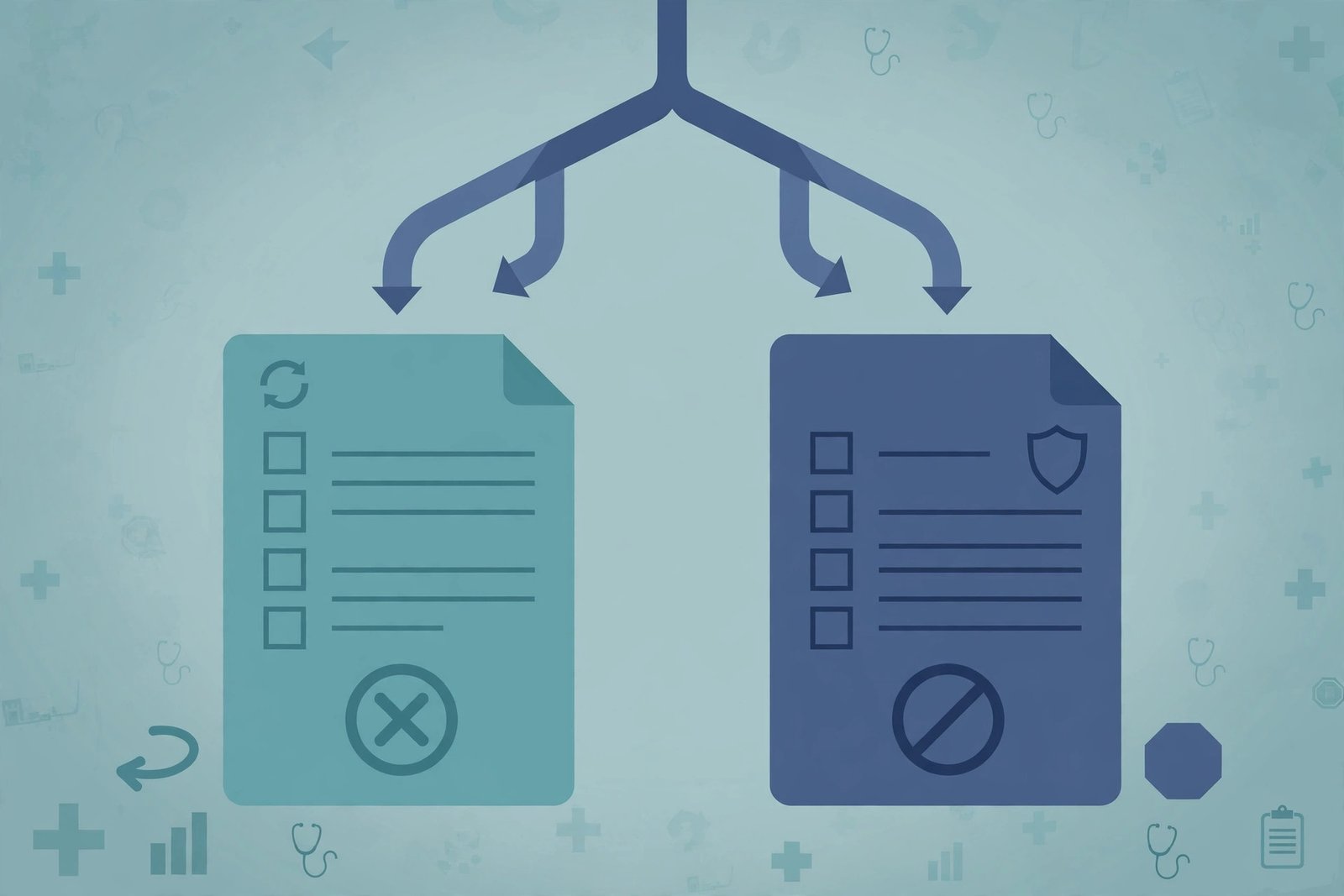
Direct answer: A claim rejection means the claim never reached adjudication — it failed a validation check, usually at the clearinghouse or the payer's front-end edits, and was returned for correction. A claim denial means the payer received the claim, adjudicated it, and decided not to pay it in full — shown on the remittance as an adjustment with a CARC code. Rejection: fix and resubmit. Denial: appeal, corrected claim, or write-off decision, depending on the code. Confusing the two is one of the most common reasons claims age past timely filing.
Why the Distinction Matters
The two stages live in different systems, carry different deadlines, and need different actions. A rejected claim is not yet a payer claim at all, so there is nothing to appeal. A denied claim has a payer decision, so resubmitting it as a brand-new claim can create a duplicate denial. Billing teams that lump both into one "denials" queue work the wrong step on roughly half their claims, and lose time on every one.
At a Glance
Rejection
- Where: clearinghouse or payer front-end edits.
- Status: not adjudicated, not a payer decision.
- Signal: clearinghouse report or front-end edit notice, often with an edit code.
- Action: correct the error and resubmit.
- Deadline risk: timely filing clock for that payer, because the claim has not yet been received as valid.
Denial
- Where: payer adjudication.
- Status: adjudicated, payment adjusted or zero.
- Signal: ERA 835 or EOB with CARC and RARC codes.
- Action: corrected claim, appeal, or write-off, decided by the code.
- Deadline risk: appeal and corrected-claim windows, plus timely filing.
Common Rejection Causes
- Missing or invalid patient or provider identifiers, such as a wrong member ID or NPI.
- Missing required fields, such as a date of service, procedure code, or diagnosis pointer.
- Invalid code combinations, such as a procedure without a valid diagnosis, or a modifier that does not match the procedure.
- Eligibility or coverage mismatches caught at the front end, such as a terminated policy.
- Format errors, such as a malformed claim file or an attachment that failed to transmit. Most rejections are data errors, and most are fixable in minutes once the edit report is read carefully.
Common Denial Causes
Missing information, contractual adjustments, medical necessity, coding, authorization, timely filing, and duplicate-claim issues. Each denial carries its own CARC and RARC, and each code carries its own correct response. A denial is not a single problem with a single fix — it is a category, and the code is the diagnosis.
The Workflow, in Order
- Step 1: Check where the claim stopped. Clearinghouse report or front-end edit notice means rejection; ERA 835 or EOB adjustment means denial.
- Step 2: For a rejection, correct the exact edit and resubmit through the clearinghouse, then confirm acceptance. Do not appeal a rejection — there is no payer decision to appeal.
- Step 3: For a denial, read the full CARC plus RARC, decide corrected claim versus appeal versus write-off, and act on the code, not on the claim total.
- Step 4: Diary a follow-up date for both. A rejected claim that is corrected but never confirmed as accepted is still unpaid; a denied claim that is appealed but never followed up will age into a write-off.
Three Errors to Avoid
- Appealing a rejection — wasted weeks, because the payer has no adjudicated claim to reconsider.
- Resubmitting a denied claim as a new original claim — this commonly creates a duplicate denial, harder to clear than the first.
- Working from a summary that strips the codes — a "rejected/denied" total without edit codes or CARC/RARC codes hides the fix. Always work from the source report or remittance, not from a summary.
What to Check First, by Type
Rejection: the clearinghouse edit report, line by line, and the claim data it points to.
Denial: the ERA 835 service line, CARC plus RARC, and the payer's manual for that combination.
If the source report is missing, get it before acting — guessing at a fix is how a simple rejection becomes a second rejection, and how a simple denial becomes a duplicate.
Frequently Asked Questions
Is a rejected claim the same as a denied claim?
No. Rejection happens before adjudication; denial happens after adjudication.
Can I appeal a rejected claim?
No. Correct the error and resubmit — there is no payer decision to appeal.
Can I resubmit a denied claim?
Only as a corrected claim where the code and payer rules allow it, with the original claim reference number where required. Resubmitting as a new original claim risks a duplicate denial.
Does a rejection count for timely filing?
A rejected claim has generally not been received as a valid claim, so the timely filing risk is real — correct and resubmit promptly, and check the payer's rules for that situation.
Which is worse, rejection or denial?
Neither is "worse" in itself — a rejection is usually faster to fix, while a denial needs a code-specific response. The costly one is whichever sits unworked.
How do I tell them apart in my reports?
By source: clearinghouse or front-end edit reports for rejections, ERA 835 or EOB adjustments for denials. If your report merges them, split it — the workflow is different.
A note on codes: CARC and RARC descriptions are summarised from the official X12 code lists and common payer usage. Always confirm a code against the official X12 list and the payer's own companion guide before acting. This article is educational information about billing workflows, not legal or compliance advice.
Related Reading
- How to Appeal a CO 16 Denial
- CARC CO 45 Billing Adjustment Explained
- How to Reduce Claim Denials
- What Is Revenue Cycle Management
- How to Reduce Days in A/R
Need help clearing rejections and denials? Neximed Billing provides claim submission, denial management, and A/R follow-up. Contact us at info@neximedbilling.com or +1-406-2251570.