CMS 1500 Box 24J: Rendering Provider NPI Rules for Each Service Line
Direct answer: Box 24J on the CMS 1500 claim form holds the rendering provider's National Provider Identifier, the NPI of the individual who actually performed or supervised the service on that line. It is almost always a Type 1, individual, NPI, entered in the unshaded, lower portion of Box 24J. In a group practice, the group's Type 2, organization, NPI goes in Box 33a, the billing provider box, while each service line's Box 24J carries the individual practitioner's Type 1 NPI. That pairing, group in 33a and individual in 24J, is the single most important rule in this article, and most Box 24J errors are a failure of that pairing: the billing NPI repeated in 24J, the rendering NPI left blank, or the two swapped.
THE FORM, IN BRIEF
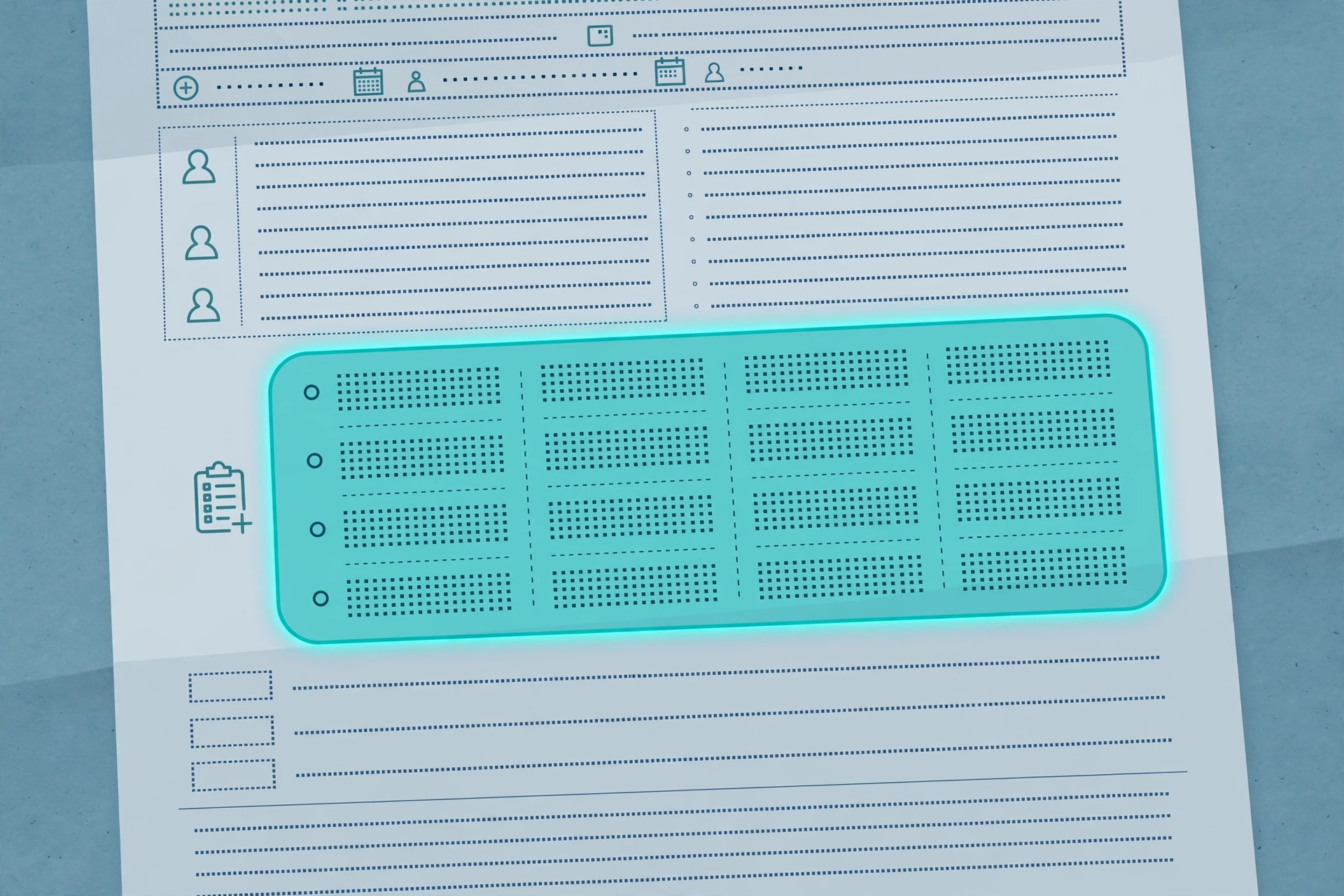
The CMS 1500 is the standard paper form for professional claims, maintained by the National Uniform Claim Committee, with the current version known as 02/12. Its 33 items run in four zones: patient and insured information, condition and diagnosis, service lines, and billing provider information. Item 24 holds up to six service lines. Each line carries a date of service, place of service, procedure code with modifiers, diagnosis pointer, charge, units, and the rendering provider fields, 24I and 24J. Because most claims are now submitted electronically, the paper form's rules still matter: the electronic 837P carries the same rendering provider information in its loops, and the same errors, a missing or wrong rendering NPI, deny in either format. Learn the paper box and the electronic equivalent follows.
SHADED VERSUS UNSHADED, PLAINLY
Each service line in Item 24 has a shaded upper half and an unshaded lower half, and the two halves do different jobs. The unshaded portion of Box 24J always holds the rendering provider's 10-digit Type 1 NPI. The shaded portion holds supplemental information only, and only where a payer requires it: a non-NPI identifier with its qualifier, or a taxonomy code where required. Box 24I, the shaded qualifier field, holds the two-character qualifier that says what kind of supplemental number follows, for example 0B for a state license number or G2 for a payer-assigned number, and ZZ where a taxonomy code is required in the shaded area of 24J. The qualifier in 24I describes the shaded number, not the NPI. A common error is to put the taxonomy code in the unshaded area, or the NPI in the shaded area, which tells the payer's system that the wrong value is the provider identifier. Keep them apart: NPI below, supplemental above, qualifier beside it.
GROUP VERSUS SOLO, SIDE BY SIDE
In a solo practice, the rendering provider and the billing provider are the same person, so the Type 1 NPI appears in both Box 24J and Box 33a, and the practice name and address in Box 33 belong to that individual. In a group practice, the two boxes split: Box 33a carries the group's Type 2 NPI and Box 33 carries the group name and address, while each line's Box 24J carries the Type 1 NPI of the individual who performed that line's service. Where a service line's rendering provider differs from the billing provider, 24I and 24J must be completed for that line; where they are the same individual, payer instructions still commonly expect the rendering NPI in 24J, so check the payer's instructions rather than leaving it blank on an assumption. Supervising provider cases, incident-to billing, and services performed by a physician assistant or nurse practitioner under supervision follow the same principle, but the question of whose NPI is the rendering NPI in those arrangements depends on the payer's rules and the supervision arrangement, so confirm it against the payer's manual before submitting, rather than defaulting to the supervising provider in every case.
THE ERRORS THAT DENY CLAIMS
The errors repeat across practices, which makes them preventable. Putting the billing, Type 2, NPI in Box 24J, so the payer cannot identify the individual who performed the service. Leaving Box 24J blank on a group claim, so the line has no rendering provider at all. Entering the taxonomy code without its ZZ qualifier, or entering the NPI in the shaded area, so the system reads the wrong field as the identifier. Using one practitioner's NPI for another practitioner's lines, usually after a copy-forward error in the practice system, which creates a mismatch between the service, the diagnosis pointer, and the provider. And submitting a legacy identifier where the payer requires the NPI, a holdover from older workflows that modern payer systems reject. Each of these is a data error, not a medical necessity dispute, so each is fixed by correcting the claim's provider fields, not by appealing the medical decision.
A PRE-SUBMISSION CHECK FOR BOX 24J
- For each service line, confirm the rendering provider named in the chart matches the NPI in Box 24J.
- Confirm the NPI is Type 1, 10 digits, and belongs to that individual, not to the group.
- Confirm Box 33a carries the billing provider's NPI, Type 2 for a group, Type 1 for a solo practice, and that the two have not been swapped.
- Confirm any shaded-area entry has its qualifier in 24I and matches the payer's requirement for that plan.
- Confirm the diagnosis pointer on the line is consistent with a service that practitioner would perform.
- Confirm the claim's rendering provider information matches what the practice system holds for that provider, including any recent enrollment or revalidation change, because a claim submitted with a terminated or unenrolled provider's NPI will deny no matter how clean the rest of the claim is.
FREQUENTLY ASKED QUESTIONS
What goes in Box 24J? The rendering provider's Type 1, individual, NPI, in the unshaded portion, for that service line.
What goes in Box 33a? The billing provider's NPI: the group's Type 2 NPI for a group practice, or the individual's Type 1 NPI for a solo practice.
What is the shaded area of 24J for? Supplemental identifiers only, where a payer requires them, such as a taxonomy code with the ZZ qualifier, or another identifier with its qualifier in 24I.
Should a solo practitioner fill in both 24J and 33a? Yes, with the same Type 1 NPI in both, unless a payer's instructions say otherwise for that plan.
What happens if Box 24J has the wrong NPI? The payer cannot match the service to its provider, and the line is commonly denied or rejected. Correct the provider fields and resubmit or correct the claim through the payer's process.
Does the electronic claim use Box 24J? The paper box maps to the rendering provider information in the electronic 837P, so the same rules apply in electronic submissions.
A note on sources and payer variation: Box descriptions in this article paraphrase the NUCC CMS 1500 reference instructions and Medicare claims processing guidance. Payer requirements for supplemental identifiers, taxonomy codes, and supervising provider reporting vary, so always confirm the specific payer's instructions for the plan being billed before submitting. This article is educational information about billing workflows, not legal or compliance advice.
Need help cleaning up provider enrollment and claim errors? Neximed Billing provides credentialing support, claim scrubbing, and denial management. Contact us at info@neximedbilling.com or +1-406-2251570.
Related reading: Common Medical Coding Errors · Insurance Eligibility Verification Process · How to Appeal a CO 16 Denial · How Long Does Medical Credentialing Take · Claim Rejection vs Claim Denial · How to Reduce Claim Denials