Podiatry Billing: Routine Foot Care, the Q7, Q8 and Q9 Class Findings, and Diabetic Shoes
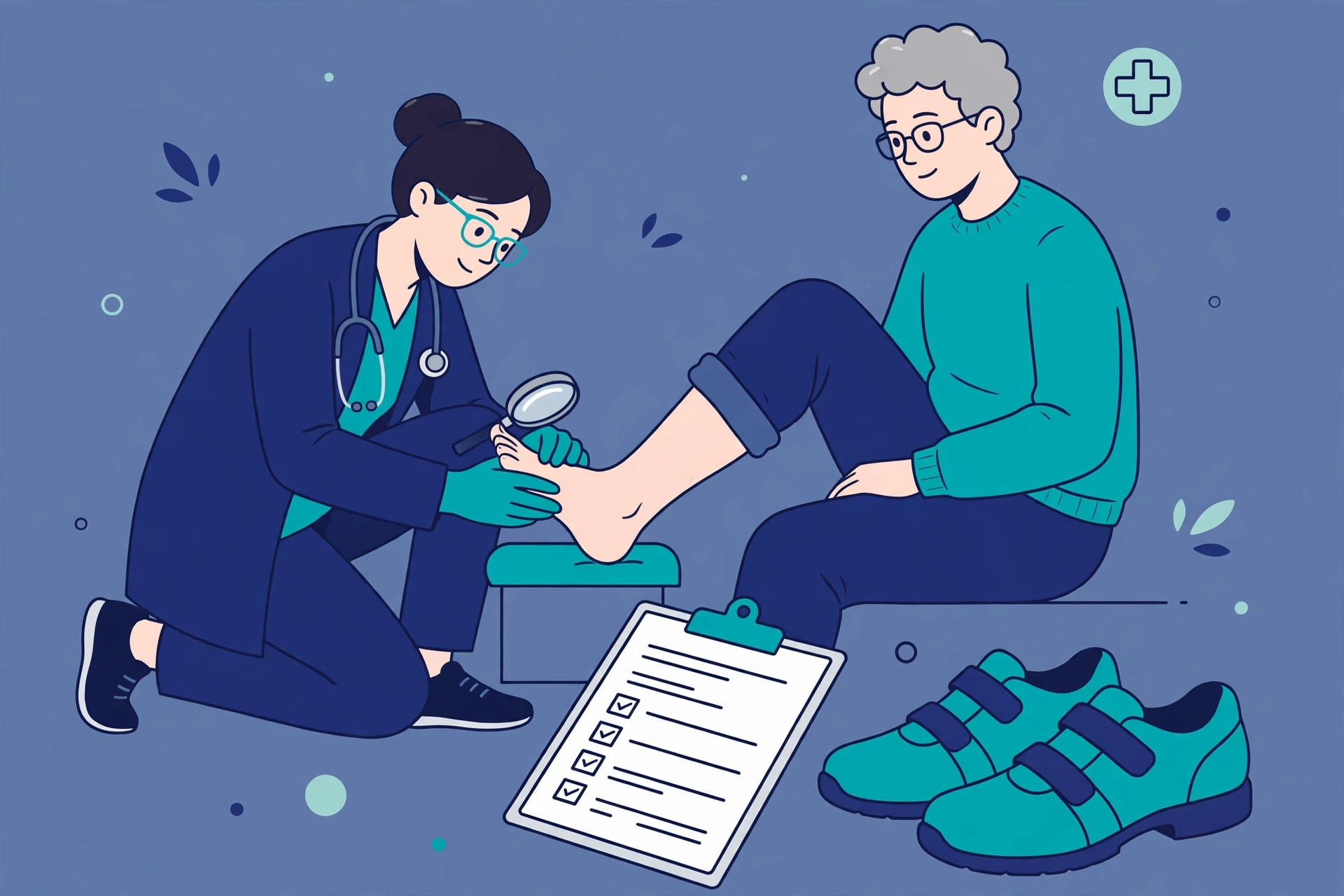
Direct answer: Medicare does not cover routine foot care. The Social Security Act, section 1862(a)(13)(C), excludes payment for the cutting or removal of corns and calluses, the trimming, cutting, clipping or debriding of nails, and other hygienic and preventive foot care, when there is no localized illness, injury or symptom involving the foot. The exclusion is the default, and the claim has to prove its way back in. Coverage returns only when two things are both true: the patient has a qualifying systemic condition of enough severity that foot care by a nonprofessional would put the patient at risk, and the record documents an objective class finding that shows severe peripheral involvement. The class finding is reported with a Q modifier, Q7 for one Class A finding, Q8 for two Class B findings, and Q9 for one Class B finding plus two Class C findings. A claim that carries the right procedure code and the right diagnosis but no Q modifier is the single most common preventable podiatry denial, and it usually comes back as a CO-50. Diabetic shoes are a separate durable medical equipment benefit, limited to one pair per calendar year, and the certifying statement must be signed by the physician who actively manages the patient's diabetes, not necessarily by the podiatrist.
THE STATUTE THAT EXCLUDES ROUTINE FOOT CARE
Section 1862(a)(13)(C) of the Social Security Act states that no Medicare payment is made for expenses incurred for services connected with the care, cutting or removal of corns, calluses or nails, and other routine hygienic foot care, in the absence of localized illness, injury or symptoms involving the foot. The Medicare Benefit Policy Manual, Chapter 15, section 290, carries the same list into the coverage manuals, and each Medicare Administrative Contractor repeats it in its local coverage determination and billing and coding article. Three groups of services fall inside the exclusion: the cutting or removal of corns and calluses, the trimming, cutting, clipping or debriding of nails, and other hygienic and preventive maintenance care, such as cleaning and soaking the feet and the use of skin creams. A healthy patient who wants toenails trimmed is asking for an excluded service, and the correct handling is an Advance Beneficiary Notice and patient responsibility, not a creative diagnosis. The exclusion is statutory, so it is not a payer preference and it is not negotiable on appeal. When the exception does not apply, the service can still be billed with modifier GY, which reports an item or service that is statutorily excluded, so that the patient or a secondary payer receives a formal denial. For a full walkthrough of the CO-50 denial and the appeal options, see How to Appeal a CO-50 Denial.
THE TWO-PART TEST: A QUALIFYING SYSTEMIC CONDITION PLUS A DOCUMENTED CLASS FINDING
The exception runs through the patient's underlying medical condition, not through the foot problem in isolation. Part one is the systemic condition: a systemic disease of sufficient severity that foot care by a nonprofessional person would put the patient at risk. The conditions cited across Medicare foot care coverage policy include diabetes mellitus, peripheral vascular disease and atherosclerosis of the extremities, peripheral neuropathy, and hereditary or degenerative disease such as amyotrophic lateral sclerosis and multiple sclerosis. The list is illustrative, not exhaustive, and each contractor publishes its own covered diagnosis list, so confirm the exact list for the treating physician's jurisdiction before coding. Part two is the class finding, an objective examination finding that proves the risk is severe enough to matter. Both halves must be documented at each and every visit where routine foot care services are rendered. A class finding carried over from a prior visit does not satisfy the requirement, and a diagnosis code alone, without the examination findings in the note, does not satisfy it either. For certain systemic conditions, the patient must also be under the active care of a doctor of medicine or a doctor of osteopathy, seen within the six months before the foot care service. The diagnoses that carry this requirement are marked in the contractor coverage lists, and the managing physician's information must be on the claim when it applies.
COVERED DIAGNOSES, CODED TO THE HIGHEST SPECIFICITY
The diagnoses below are the ones most often seen on covered routine foot care claims. They are examples drawn from the coverage lists, not a complete list, and each contractor's list controls. Type 2 diabetes with foot complications is reported with codes from the E11.4x, E11.5x and E11.6x families, and the fifth and sixth characters matter, because they distinguish neuropathy from angiopathy from ulcer. E11.40 is type 2 diabetes mellitus with diabetic neuropathy, unspecified. E11.610 is type 2 diabetes mellitus with diabetic neuropathic arthropathy. E11.51 is type 2 diabetes mellitus with diabetic peripheral angiopathy without gangrene. E11.621 is type 2 diabetes mellitus with foot ulcer, and it should be used only when the record documents an ulcer. Peripheral vascular disease is I73.9, peripheral vascular disease, unspecified, and atherosclerosis of the native arteries of the extremities is I70.209 when laterality and gangrene are not further specified. Fungal infection of the nail is B35.1, tinea unguium, and it supports the mycotic nail pathway described later in this article. An ingrowing nail is L60.0, and onychogryphosis, the thickened, curved, claw-like nail, is L60.2. Read the note before choosing the code, and never code a complication the note does not describe.
| Diagnosis code | What it describes | Where it is used |
|---|---|---|
| E11.40 | Type 2 diabetes with diabetic neuropathy, unspecified | Systemic condition supporting the exception |
| E11.610 | Type 2 diabetes with diabetic neuropathic arthropathy | Systemic condition, Charcot-type joint disease |
| E11.51 | Type 2 diabetes with diabetic peripheral angiopathy without gangrene | Systemic condition, vascular involvement |
| E11.621 | Type 2 diabetes with foot ulcer | Systemic condition, only when an ulcer is documented |
| I73.9 | Peripheral vascular disease, unspecified | Systemic condition, vascular involvement |
| I70.209 | Atherosclerosis of native arteries of extremities, unspecified | Systemic condition, vascular involvement |
| B35.1 | Tinea unguium | Mycotic nail pathway for 11720 and 11721 |
| L60.0 | Ingrowing nail | Local nail condition |
| L60.2 | Onychogryphosis | Local nail condition, thickened deformed nail |
THE CLASS FINDINGS SYSTEM: CLASS A, CLASS B AND CLASS C
Medicare organizes the examination evidence into three classes of findings, and the combination documented in the note decides which Q modifier the claim carries. The classification comes from the Medicare Benefit Policy Manual, Chapter 15, section 290.4, and it is repeated in the contractor billing and coding articles. Class A has one finding: nontraumatic amputation of the foot or an integral skeletal portion of the foot. One Class A finding alone qualifies the patient, and it is reported with modifier Q7. Class B findings are physical examination findings of severe peripheral involvement: absent posterior tibial pulse, absent dorsalis pedis pulse, and advanced trophic changes, evidenced by three of five signs, decrease or absence of hair growth, nail thickening, pigmentary change, thin and shiny skin texture, and rubor or redness. Two Class B findings qualify the patient, and they are reported with modifier Q8. Class C findings are supportive signs: claudication, temperature changes such as cold feet, edema, paresthesias, and burning. Class C findings cannot carry a claim on their own. They count only with a Class B finding, and that combination is reported with modifier Q9. The systemic condition is part one of the two-part test, and the class finding is part two.
| Class | What it contains | How many are needed |
|---|---|---|
| Class A | Nontraumatic amputation of the foot or an integral skeletal portion of the foot | One Class A finding alone qualifies |
| Class B | Absent posterior tibial pulse; absent dorsalis pedis pulse; advanced trophic changes shown by three of five signs, hair decrease or absence, nail thickening, pigmentary change, thin shiny skin texture, rubor or redness | Two Class B findings qualify |
| Class C | Claudication; temperature changes such as cold feet; edema; paresthesias; burning | Never alone; two Class C findings plus one Class B finding qualify |
THE Q7, Q8 AND Q9 MODIFIER LOGIC
The Q modifiers are not optional. They tell the claims system which class finding justifies coverage, and they must be appended to the routine foot care procedure codes. Modifier Q7 means one Class A finding is present and documented. Modifier Q8 means two Class B findings are present and documented. Modifier Q9 means one Class B finding and two Class C findings are present and documented. The modifiers are reported with CPT codes 11055, 11056 and 11057, 11719, and HCPCS code G0127, and with CPT codes 11720 and 11721 when coverage is based on a qualifying systemic condition. A claim needs both a qualifying systemic-condition diagnosis code and the matching Q modifier to pay. A missing Q modifier on an at-risk patient is the most common preventable denial in this service line, and it shows up as a CO-50, because without the modifier the claim looks like ordinary routine foot care, which the statute excludes. The modifier must match the findings documented in that visit's note.
THE CODE TABLE: PARING, TRIMMING AND DEBRIDEMENT
The procedure codes split by what was done and, for nails, by how many nails were treated. Paring or cutting of benign hyperkeratotic lesions, such as corns and calluses, is 11055 for a single lesion, 11056 for two to four lesions, and 11057 for more than four lesions. Report one paring code per session, the one that matches the total lesion count. Trimming of nondystrophic nails, any number, is 11719. Trimming of dystrophic nails, any number, is G0127, a HCPCS Level II code. Debridement of nails by any method is 11720 for one to five nails and 11721 for six or more nails. Trimming cuts the nail back, while debridement reduces nail thickness, and the note should describe what was actually done. Toe modifiers from the T series identify the digit treated, T1 through T5 for the left foot and T6 through T10 for the right foot, with TA for the left great toe.
| Code | Description | Coverage path |
|---|---|---|
| 11055 | Paring or cutting of a benign hyperkeratotic lesion, single lesion | Systemic condition with class findings, Q7, Q8 or Q9 |
| 11056 | Paring or cutting of benign hyperkeratotic lesions, two to four lesions | Systemic condition with class findings, Q7, Q8 or Q9 |
| 11057 | Paring or cutting of benign hyperkeratotic lesions, more than four lesions | Systemic condition with class findings, Q7, Q8 or Q9 |
| 11719 | Trimming of nondystrophic nails, any number | Systemic condition with class findings, Q7, Q8 or Q9 |
| G0127 | Trimming of dystrophic nails, any number | Systemic condition with class findings, Q7, Q8 or Q9 |
| 11720 | Debridement of nail or nails by any method, one to five nails | Systemic condition with class findings, or mycotic nail criteria |
| 11721 | Debridement of nail or nails by any method, six or more nails | Systemic condition with class findings, or mycotic nail criteria |
THE MYCOTIC NAIL EXCEPTION, AND WHAT IT DOES NOT COVER
There is one established route to coverage that does not run through the systemic-condition class findings, and it applies only to debridement of mycotic nails, codes 11720 and 11721. Debridement of mycotic nails is covered when the record shows clinical evidence of mycosis plus, for an ambulatory patient, marked limitation of ambulation, pain, or secondary infection caused by the thickened, dystrophic nail. A diagnosis of onychomycosis, B35.1, can support 11720 or 11721 on this pathway, but the claim still needs the clinical evidence in the note. This exception is narrow, and it is often overstated. It does not turn 11719 or G0127 into a way around documenting the systemic condition. Trimming of nondystrophic nails and trimming of dystrophic nails remain routine foot care, and when billed as routine foot care they still need the qualifying systemic condition and the matching Q modifier. Do not present 11719 or G0127 as a workaround for a missing class finding; that reading is not supported by the coverage articles.
THE 60-DAY FREQUENCY RULE
Routine foot care that qualifies for the exception is not unlimited. The Medicare Benefit Policy Manual and the contractor articles state that routine foot care procedures can only be performed once in a 60-day period, and most contractors express the same rule as once every 61 days between visits, which is the same interval counted from the day after the prior service. A visit inside the window will deny, commonly as a CO-151 for a frequency limitation. More frequent care needs documented medical necessity that goes beyond the routine schedule, and the documentation must explain why the earlier return was required. The frequency rule applies per patient, not per code, so splitting the same visit across two codes does not create a second covered visit. When a patient must be seen sooner for a non-covered reason, an Advance Beneficiary Notice should be on file. Before booking a routine foot care visit, confirm the date of the last covered service and count the days. The treating physician's contractor article is the authority for the exact count in that jurisdiction.
DIABETIC SHOES AS DME: A SEPARATE BENEFIT WITH SEPARATE RULES
Therapeutic shoes for persons with diabetes are not routine foot care. They are a durable medical equipment benefit under the Therapeutic Shoe Bill, section 4149 of the Omnibus Budget Reconciliation Act of 1987, and they are billed through the DMEPOS benefit, not through the physician fee schedule. That distinction drives everything else: the supplier must be enrolled as a DMEPOS supplier, the documentation rules come from the DMEPOS policies, and the claim goes to the durable medical equipment contractor. Medicare covers one pair of therapeutic shoes per calendar year for a qualifying patient, plus inserts. The standard allowance is one pair of extra-depth shoes, HCPCS code A5500, and three pairs of custom-molded inserts, A5512 or A5513. When a foot deformity means standard extra-depth shoes cannot accommodate the foot, the alternative is one pair of custom-molded shoes, A5501, and two additional pairs of inserts. Modifications are reported with codes from the A5503 through A5508 range, and Medicare will reimburse modifications up to the limit set for the inserts to which the patient is entitled. When reporting the shoes, bill two units, one per shoe, for each pair. Modifier KX must be appended to the diabetic shoe and insert claims, because it attests that the documentation requirements have been met, and claims billed without KX will be denied as noncovered.
THE DIABETIC SHOE QUALIFICATION CHECKLIST
Three criteria must all be met. First, the patient has diabetes mellitus and is enrolled in Medicare Part B. Second, the patient has at least one qualifying foot condition: previous amputation of the other foot or part of either foot, history of previous foot ulceration, history of pre-ulcerative calluses, peripheral neuropathy with evidence of callus formation, foot deformity, or poor circulation. A diabetes diagnosis alone does not qualify. Third, the certifying physician who is managing the patient's diabetes has certified that the first two criteria are met, that the patient is being treated under a comprehensive plan of care for diabetes, and that the patient needs diabetic shoes. The certifying statement must be signed by the physician actively managing the patient's diabetes, typically a doctor of medicine or a doctor of osteopathy. A podiatrist may prescribe the specific shoe, and one enrolled as a DMEPOS supplier may fit and supply the shoes, but the podiatrist cannot sign the certifying statement. The written, signed and dated order must reach the supplier before the claim is submitted. Medicare generally pays 80 percent of the approved amount after the annual Part B deductible, with the patient responsible for the remaining 20 percent. A new pair each year is not guaranteed: document that the prior pair is non-functional or in poor condition before dispensing another pair. For the full DMEPOS documentation rules, see DMEPOS Billing: Medicare Documentation Requirements.
| Item | Code | Annual limit |
|---|---|---|
| Extra-depth shoes, off-the-shelf, per shoe | A5500 | One pair per calendar year, bill two units |
| Custom-molded shoes, per shoe | A5501 | One pair per calendar year, bill two units |
| Custom-molded inserts, per pair | A5512 or A5513 | Three pairs per calendar year with A5500, two pairs with A5501 |
| Shoe modifications | A5503 through A5508 | Up to the insert limit to which the patient is entitled |
SAME-DAY EVALUATION AND MANAGEMENT, AND THE BUNDLING PROBLEM
A separate evaluation and management service on the same day as routine foot care is billable only when it is a significant, separately identifiable service, reported with modifier 25, and supported by documentation that goes beyond the foot care itself. The contractor billing articles state plainly that it is inappropriate and incorrect to report an evaluation and management code when routine foot care or a nail trimming or debridement service is the service actually performed, and a same-day line without modifier 25 and without separate documentation commonly returns as a CO-97, a bundled or inclusive service.
THE LOCAL COVERAGE DETERMINATION: L33645 IS WIDELY REFERENCED, NOT UNIVERSAL
The most widely referenced local coverage determination for routine foot care is L33645, and it appears in billing guides across the country. It is not universal. Each Medicare Administrative Contractor publishes its own local coverage determination and billing and coding article, with its own number, its own covered diagnosis list and sometimes its own wording, and the Novitas Solutions determination L35138 is one example of a different contractor's document covering the same services. Verify the reader's contractor determination and billing and coding article for the jurisdiction where the service was furnished before coding.
WORKED EXAMPLE, ALL FIGURES ILLUSTRATIVE
A 68-year-old patient with type 2 diabetes and peripheral vascular disease presents for routine foot care. The note documents diabetes with diabetic peripheral angiopathy, E11.51, and atherosclerosis of the native arteries, I70.209. On examination the posterior tibial pulse is absent on both feet, the dorsalis pedis pulse is absent on the right foot, and the skin shows advanced trophic changes, with hair loss, thickened nails and thin, shiny skin, three of the five trophic signs. The documented findings are two Class B findings, so the claim carries modifier Q8. The service is debridement of six or more nails, code 11721 with modifier Q8, plus paring of three calluses, code 11056 with modifier Q8. The last covered visit was 74 days earlier, so the 60-day rule is satisfied, and the managing physician was last seen four months earlier, so the active care requirement is satisfied. If the same patient returned 40 days later, the claim would deny for frequency even with identical findings, and the correct handling would be an Advance Beneficiary Notice and patient responsibility, or a later appointment.
COMMON MISTAKES THAT TRIGGER DENIALS
The most common mistakes are a missing Q modifier, which turns a covered service into a statutory exclusion and returns a CO-50; a Q modifier that does not match the documented findings; billing 11719 or G0127 as a workaround for a missing systemic condition; billing a visit inside the 60-day period without checking the date of the last covered service; billing an evaluation and management code on the same day without a separate, identifiable service and modifier 25, which returns as a CO-97; a diabetic shoe claim without the certifying physician statement, or with the statement signed by the podiatrist instead of the physician managing the diabetes, which returns as a CO-16; a diabetic shoe claim from a practice that is not enrolled as a DMEPOS supplier, or a claim billed without modifier KX; a diagnosis coded to a lower specificity than the note supports, which returns as a CO-11; relying on L33645 as if it were national policy; and carrying class findings forward from a prior visit instead of documenting them fresh at each visit.
DENIAL TABLE: WHAT EACH CODE MEANS AND WHAT TO FIX
The denial codes below are the ones most often seen on podiatry claims, with the usual cause and the usual fix. The full denial code reference is the pillar guide, Claim Denial Codes: Complete Guide.
| Denial code | What it means | Usual cause in podiatry | What to fix |
|---|---|---|---|
| CO-50 | Noncovered service, not deemed medically necessary | Routine foot care without a qualifying condition or Q modifier | Document the condition and class findings, append the matching Q modifier, or bill with GY |
| CO-97 | Payment included in another service, bundled | Nail care with a same-day evaluation and management service | Bill the evaluation and management service only with modifier 25 and separate documentation |
| CO-16 | Claim or service lacks information needed for adjudication | Diabetic shoe claim without the certifying physician statement, or without DMEPOS supplier enrollment | Obtain the signed certifying statement before dispensing, and confirm DMEPOS enrollment |
| CO-151 | Frequency limitation, service performed too soon | Routine foot care inside the 60-day period, or a second pair of diabetic shoes inside the calendar year | Check the date of the last covered service before scheduling, and use an Advance Beneficiary Notice |
| CO-11 | Diagnosis inconsistent with the procedure | Diagnosis coded below the specificity the note supports | Code to the highest specificity the documentation supports, and confirm the diagnosis is on the contractor's covered list |
CHECKLIST
Confirm the service is routine foot care under section 1862(a)(13)(C), and identify the exception before coding. Document the qualifying systemic condition and the class findings at this visit, fresh, not carried forward from a prior note. Match the Q modifier to the findings: Q7 for one Class A finding, Q8 for two Class B findings, Q9 for one Class B finding plus two Class C findings. Choose the procedure code by what was done and by count: 11055, 11056 or 11057 by lesion count with one code per session, 11719 for nondystrophic trimming, G0127 for dystrophic trimming, 11720 for one to five nails, 11721 for six or more. Do not use 11719 or G0127 as a way around the systemic condition. For mycotic nail debridement, document mycosis plus pain, infection or marked limitation of ambulation. Confirm the active care requirement when the diagnosis carries it, and confirm the managing physician was seen within the prior six months. Check the date of the last covered service and confirm the 60-day period has run, or use an Advance Beneficiary Notice. Code the diagnosis to the highest specificity the note supports, and confirm it is on the contractor's covered list. Bill a same-day evaluation and management service only with modifier 25 and separate documentation. For diabetic shoes, confirm diabetes plus a qualifying foot condition, obtain the certifying statement signed by the physician actively managing the diabetes, confirm DMEPOS enrollment, append modifier KX, bill two units per pair, and respect the once-per-calendar-year limit. Verify the reader's own contractor determination and billing and coding article, and do not treat L33645 as universal.
FREQUENTLY ASKED QUESTIONS
Is routine foot care covered by Medicare? No, not by default. Section 1862(a)(13)(C) excludes it, and coverage returns only with a qualifying systemic condition and a documented class finding. What are the class findings? Class A is nontraumatic amputation of the foot. Class B findings are absent posterior tibial pulse, absent dorsalis pedis pulse, and advanced trophic changes shown by three of five signs. Class C findings are claudication, cold feet, edema, paresthesias and burning. What does modifier Q7 mean? One Class A finding is present and documented. What does modifier Q8 mean? Two Class B findings are present and documented. What does modifier Q9 mean? One Class B finding and two Class C findings are present and documented. Do I need a Q modifier on every routine foot care claim? Yes, when coverage is based on a qualifying systemic condition. Without it the claim usually denies as a CO-50. What is the difference between 11719, G0127, 11720 and 11721? 11719 is trimming of nondystrophic nails, any number. G0127 is trimming of dystrophic nails, any number. 11720 is debridement of one to five nails, and 11721 is debridement of six or more nails. Can 11719 or G0127 bypass the systemic condition requirement? No. The narrow exception applies only to debridement of mycotic nails, 11720 and 11721, when the record shows clinical evidence of mycosis plus pain, secondary infection or marked limitation of ambulation. How often can routine foot care be billed? Once in a 60-day period, which most contractors express as once every 61 days between visits. How often does Medicare cover diabetic shoes? One pair of therapeutic shoes per calendar year, plus three pairs of custom-molded inserts with extra-depth shoes, or two pairs with custom-molded shoes. Who must sign the diabetic shoe certifying statement? The physician actively managing the patient's diabetes, typically a doctor of medicine or a doctor of osteopathy. A podiatrist may prescribe and fit the shoes but cannot sign the certifying statement. Does the practice need separate enrollment to supply diabetic shoes? Yes. It must be enrolled as a DMEPOS supplier, and the shoe claim is a DMEPOS claim. Can I bill an evaluation and management visit on the same day as routine foot care? Only when it is a significant, separately identifiable service, documented separately and reported with modifier 25. What should I do when a routine foot care claim denies as a CO-50? Check the Q modifier, the class findings in the note, the diagnosis specificity, and the active care requirement, in that order.
A note on codes and coverage: This article is educational information about medical billing rules, not legal, financial or compliance advice. Codes, coverage rules and payer policies vary and change over time, so always verify the current rule against the CMS manuals and the specific payer policy before acting. The worked example uses illustrative figures only. The class findings and the Q7, Q8 and Q9 definitions were verified against the Medicare Benefit Policy Manual, Chapter 15, section 290.4, and the CMS billing and coding article for routine foot care. The diabetic shoe benefit was verified against the Medicare Benefit Policy Manual, Chapter 15, section 140, and the DMEPOS therapeutic shoe policy. The 60-day frequency rule was verified against the Medicare Benefit Policy Manual and contractor articles. No payment rates are stated, because fee schedule amounts vary by locality and change annually.
Having trouble with podiatry billing, or with routine foot care and diabetic shoe denials? Neximed Billing provides denial management, corrected claim review and billing workflow support. Contact us at info@neximedbilling.com or +1-406-2251570.
Related reading: DMEPOS Billing: Medicare Documentation Requirements · How to Appeal a CO-50 Denial · Claim Denial Codes: Complete Guide